How to Read 1-Hour PM2.5 Readings During Haze
Singapore’s Ministry of Manpower (MOM) has issued additional guidance to help employers protect outdoor workers during periods of haze.
How is the 1-hour PM2.5 reading calculated?
PM2.5 refers to fine particulate matter with a diameter of 2.5 micrometres or smaller. The reading is expressed in micrograms per cubic metre (µg/m³).
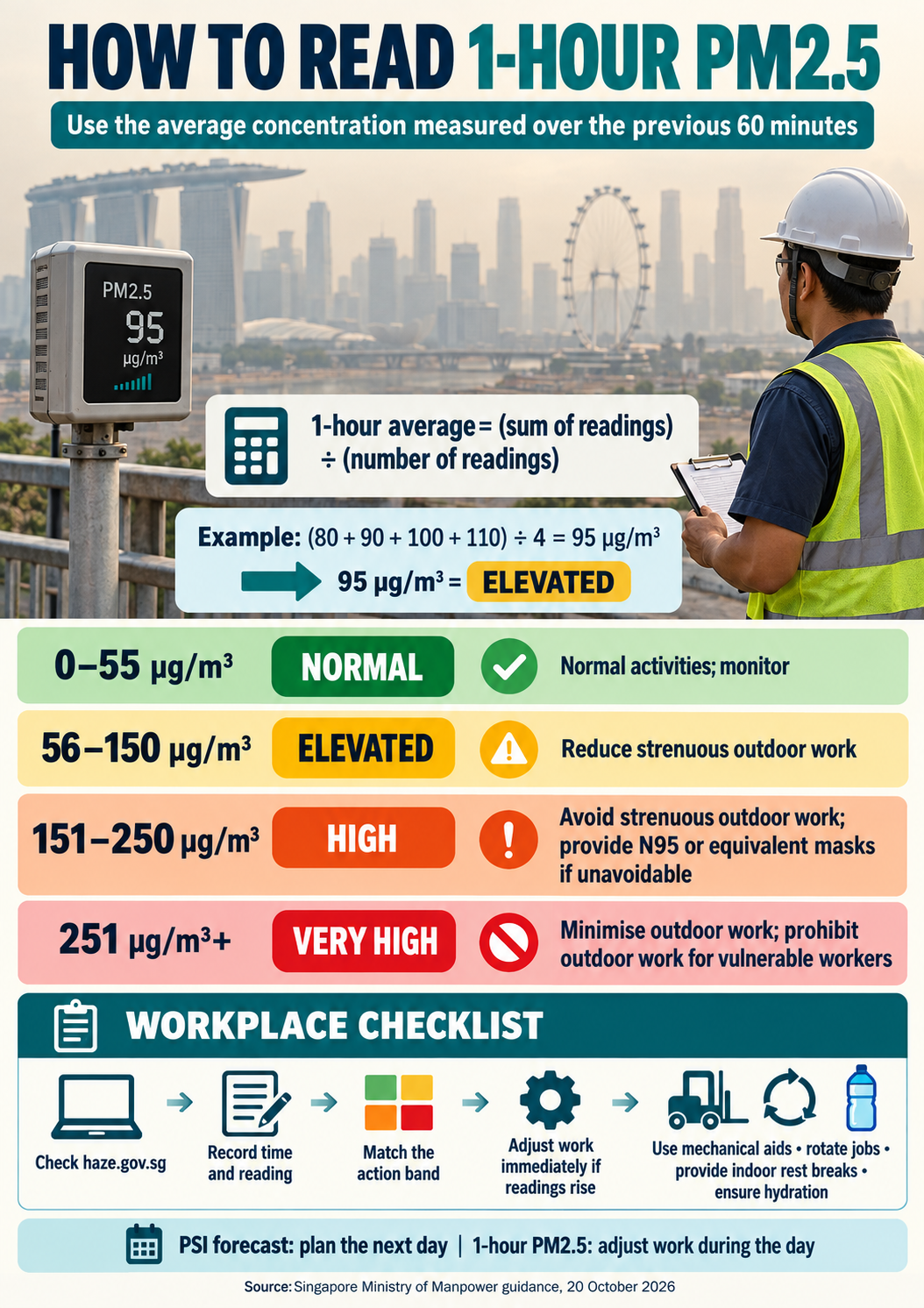
The 1-hour PM2.5 reading is the average concentration measured over the previous 60 minutes:
1-hour average = (sum of readings) ÷ (number of readings)
Example: (80 + 90 + 100 + 110) ÷ 4 = 95 µg/m³
A result of 95 µg/m³ falls within MOM’s Elevated band.
MOM’s PM2.5 action bands
0–55 µg/m³ — Normal: Normal activities may continue, while monitoring the haze situation.
56–150 µg/m³ — Elevated: Reduce strenuous outdoor work. Vulnerable workers should avoid strenuous outdoor work.
151–250 µg/m³ — High: Avoid strenuous outdoor work. If it cannot be avoided, provide N95 or equivalent masks. Vulnerable workers should avoid outdoor work.
251 µg/m³ and above — Very High: Minimise outdoor work and prohibit outdoor work for vulnerable workers. If work cannot be avoided, provide suitable masks or respirators and hourly indoor rest breaks of around 10–15 minutes.
Workplace checklist
• Check the official readings at haze.gov.sg.
• Record the time and PM2.5 reading.
• Match the reading to the correct action band.
• Adjust work immediately if readings rise.
• Use mechanical aids, rotate jobs, provide indoor rest breaks and ensure adequate hydration.
Employers should use the PSI forecast to plan outdoor work for the following day and use 1-hour PM2.5 readings to make timely adjustments during the workday. PSI and PM2.5 are different measurements and should not be converted from one another.
Vulnerable workers include elderly employees, pregnant women and people with chronic heart or lung disease.
Source: Ministry of Manpower, “Additional Guidance for Employers on Use of 1-Hour PM2.5 Readings to Protect Outdoor Workers During Haze”, 20 October 2026.
This article summarises MOM’s guidance and should not replace an employer’s own risk assessment or workplace safety procedures.